TeachWell’s research and learning products generate evidence on what works to support teacher professional development and improve learning in complex education environments. These insights inform education systems, policymakers, and partners seeking scalable, cost-effective approaches to strengthening teaching and learning.

Teacher Well-Being Protocol
Teachers are instrumental in ensuring safe and secure environments that support learner achievement and well-being especially in conflict-affected contexts. Yet these teachers, in need of mental health and psychosocial support themselves, often receive limited incentivization, professional development and income for basic needs like food to cope under these complex conditions. This is exacerbated by teaching conditions in overcrowded multilingual, multicultural, mixed-ability classrooms. Informed by Bronfenbrenner’s (1979) socio-ecological model, this study seeks to establish the status of teacher well-being, including factors that affect it, psycho-social support mechanisms available, coping strategies and teachers ’mental literacy with a focus on Garissa and Turkana counties.
The goal is to generate evidence to inform teacher professional development as well as advocacy for policies and programs with relevant stakeholders at county and national levels, towards better support for teacher well-being in refugee contexts. We will conduct a rapid desk review for information on what works towards optimizing teacher well-being in refugee contexts within SSA. We will also use surveys and in-depth interviews with teachers for experiential perspectives as well as key informant interviews with head teachers and policy actors for administrative and policy insights respectively. Finally focus group discussions with women teachers will provide insights into the gender dynamics around teacher well-being.
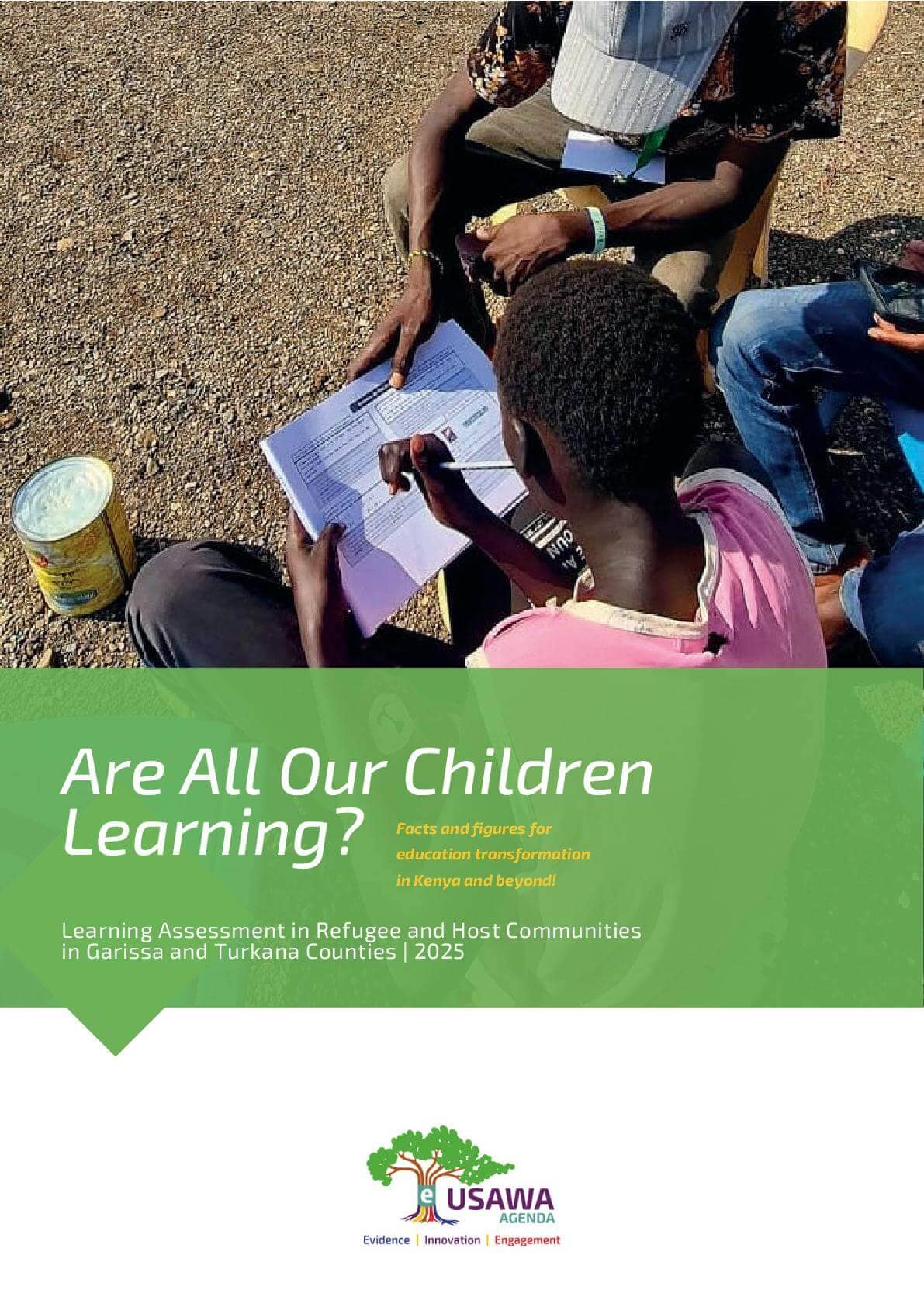
Refugee Learning Assessment Report - Usawa Agenda
Turkana counties, covering refugee populations in Dadaab, Kakuma, and Kalobeyei camps alongside surrounding host communities. mplemented by Usawa Agenda in partnership with the International Rescue Committee (IRC), the assessment represents an important step toward addressing long-standing evidence gaps by systematically including refugee learners within Kenya’s national Foundational Literacy and Numeracy Assessment (FLANA) framework.
Kenya has established a policy foundation for the inclusion of refugees within the national education system through instruments such as the Refugee Act (2021) and alignment with the Global Refugee Education Strategy. However, implementation remains at an early stage, and refugee learners have historically been excluded
from national learning assessments, limiting the availability of comparable evidence on access, learning outcomes, and equity. This assessment responds to that gap by generating robust, comparable data on schooling participation, learning environments, and foundational learning outcomes for children aged 10–15 years
and learners in Grades 3–9, whether in school or out of school.
MHPSS Manual Pilot Test Report
One of the most widely adopted methods of introducing a new product for implementation is through pilot testing to a smaller group of subjects. Mental Health and Psychosocial Support (MHPSS) manual for the Teachwell education project-aims at ensuring teachers’ mental wellbeing in two project implementation counties; Garissa and Turkana. The International Rescue Committee, together with education stakeholders; Ministry of Education, Lutheran World Federation, piloted the manual with 52(34M,18F) teachers and 8(3F,5M) Curriculum Support Officers (CSOs) in both Kakuma and Dadaab refugee camps of Turkana and Garissa counties.
The report presents findings from the pilot evaluation of the Mental Health and Psychosocial Support (MHPSS) manual training conducted for the teachers. The assessment focused on the manual’s clarity, relevance, cultural appropriateness, and training methodology.
Rapid WASH Needs Assessment Report
Sufficient availability of water, sanitation, and hygiene (WASH) amenities is an essential human entitlement. It is required to achieve improved health, education, nutrition, and other indicators of human development, as well as to realize all human rights. WASH also helps achieve other development objectives, especially those concerning gender equality, resilience, urban services, poverty and economic growth, and climate change. Water and sanitation access affects children's lives and their capacity to grow and develop, and it is linked to many other important issues.